
Teaching Limiting Reagents: A Simple Demo and Lab That Make Stoichiometry Click
Why Students Struggle with Limiting Reagents
Even with our best efforts, it can be hard for some students to comprehend what a limiting reagent really does in a reaction. Many high school chemistry students struggle to understand limiting reagents in stoichiometry because they cannot visualize which reactant actually “runs out” first. In between my first and second Alka-Seltzer chemistry lab yesterday, I introduced a very simple demo that really helped. Even though I had used real-life examples like making s’mores and making bikes, as soon as I asked about how an Alka-Seltzer worked, they froze. Students often understand everyday analogies, but they struggle to connect those analogies to real chemical reactions. To make the reaction between the citric acid and the sodium bicarbonate in the tablet more visible, I made a very extreme demo to clearly demonstrate the concept of a limiting reactant in a chemical reaction.
A Simple Visual Limiting Reagent Demo Using Vinegar and Baking Soda
I put about 50 mL of baking soda in one beaker and 50 mL of vinegar in another. Then I added one drop of vinegar to the baking soda. It fizzed for a split second and then stopped. I asked the class, was H+ or NaHCO3- the limiting reagent? Obviously, it was the H+. But how did you know? The primary answer they gave was that you could still see the baking soda. I made them connect it to the reaction.

How the Demo Makes the Limiting Reactant Obvious
Since the reaction stopped, and there is obviously still NaHCO3- in the beaker, then H+ must have run out, stopping the reaction. the reaction between acetic acid (vinegar) and sodium bicarbonate stops while solid NaHCO₃ remains, students can visually infer that the acid (H⁺) was the limiting reagent. What happens if I put in 1 mL of vinegar? It will fizz longer. Obviously. I continued to take this logic to the extreme, when they were forced to say that adding more vinegar wouldn’t make the reaction go any further. Then the NaHCO3- would be the limiting reagent. This visual progression helps students understand that the limiting reagent determines when a chemical reaction stops and therefore determines the theoretical yield.
Pro Tip for Teaching Limiting Reagent Calculations
Pro-tip: While working in limiting reagent problems, constantly ask students how much limiting reagent remains when the theoretical yield has been produced mathematically. The answer is zero — by definition, a limiting reagent is completely consumed. It reinforces their understanding of why the reaction stopped.
Connecting the Demo to an Alka-Seltzer Limiting Reagent Lab
Then I connected it back to the Alka-Seltzer. What would be true about the amount of NaHCO3- which is an antacid, if the NaHCO3- was the limiting reagent in the tablet? There wouldn’t be any. And that wouldn’t make it a very effective medicine. In commercial tablets like Alka-Seltzer, the acid is intentionally the limiting reagent so that sodium bicarbonate (the antacid) remains in excess.
After the students saw the demo, and connected it to the function of the acid in the tablet, they were able to correctly predict that the acid has to be the limiting reagent. This bridges conceptual understanding and real-world medical design
Free Limiting Reagent Lab for High School Chemistry
This led the class straight into the Alka-Seltzer lab (blog post here), a high school chemistry limiting reagent lab activity. You can download the printout below.
How much antacid actually reaches your stomach? The kids enjoy it, because they feel like they are taking down big pharma by using limiting reagents. One simple demo, one simple lab. The outcome is improved understanding of limiting reagent. If you teach stoichiometry or limiting reagent calculations in high school chemistry, this demo can dramatically improve student comprehension.
Plus, kids like fighting big pharma and watching things fizz. Sounds like a win-win to me.
If students struggle with limiting reagents or stoichiometry, they don't need more worksheets — they need interaction.
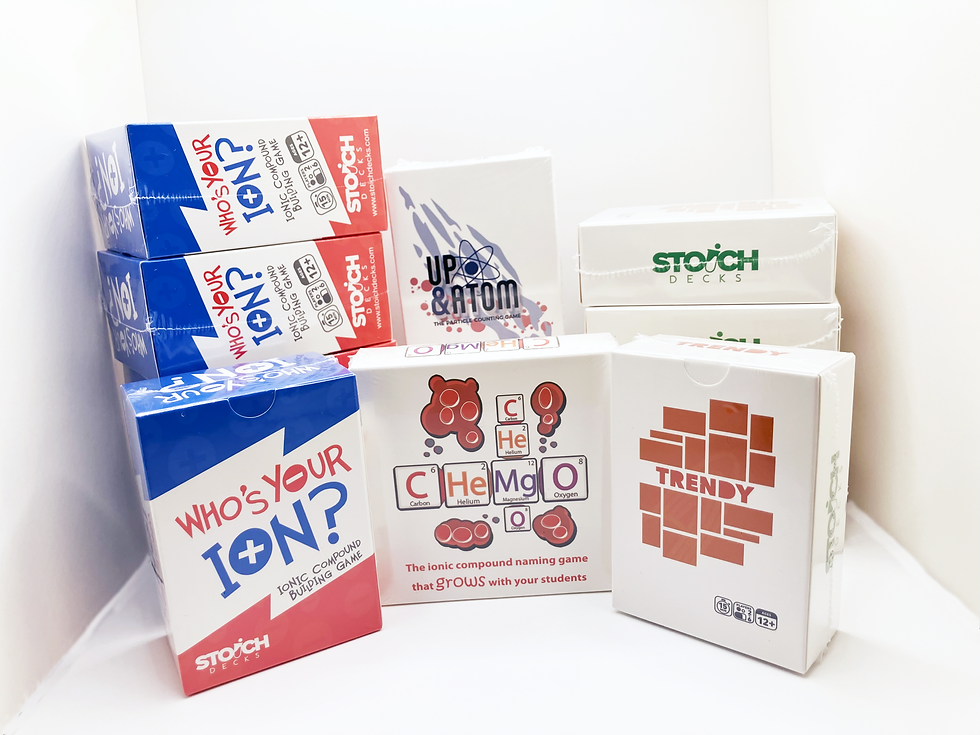
Stoich Decks’ complete set of chemistry games strengthens real chemical reasoning through competition and strategy, serving up to 30 students at once.
Less passive learning. More chemistry conversations.


Thank you - started our limiting reactant lesson with the baking soda/vinegar demo and they got it! They defined what a limiting reactant was before we started taking notes and we calculated with a purpose.