
What Sweaty Skittles Can Teach You About Classroom Game Design
My nephew asked a question this week as we were backpacking.
“Can we make a game out of these?”
“These” were sweaty Skittles that had started to donate their color to his palms and stick together. Of course we can. We can make a game out of anything. For the next two hours we played games using only sweaty Skittles as we sat on our rock by the lake until dark and then we moved the game into the tent. His engagement with these games was off the charts.

If a 12-year old can be engrossed (pun intended) with sweaty Skittle games, imagine what your chemistry students can do when you take a lesson and turn it into a game.
Below, I will highlight some key parts of game development that will make gamifying your classroom more memorable and the lessons more powerful.
Keep the key teaching concept central
One of the key failures for teachers when they design classroom games is losing the teaching point. You are designing this lesson on purpose. You know what you want the students to know and be able to do at the end of it. Make sure the game hinges on that idea. Don’t just make a game where you earn atoms instead of points and call it a lesson. Instead, make the key strategic decision about the lesson. That way, when the kids are trying to win, they are engaging with the material you want them to know.
Putting the key concept right at the strategic center makes the students engage.
Use familiar game mechanisms
I know that I am a game-design nerd. I love dreaming of new game mechanics. But your chemistry lesson is not the time to create a new monstrosity of a way to play a game. Use familiar game mechanics so that the students can use their brainpower to understand chemistry concepts and not focusing on the heavy mechanics of how to win the game.
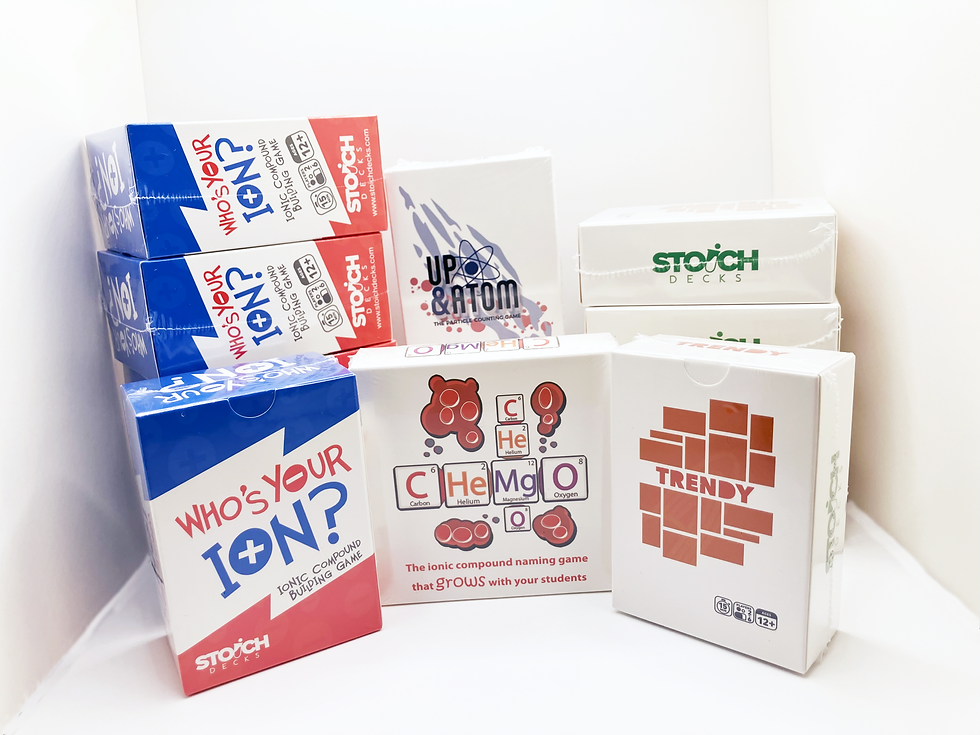
A few years ago, after playing Up & Atom, a student asked if I stole the game from The Skull King. I told them I had not, but that proved I was using a mechanic that was familiar. Bid on the number of tricks you will take. That is the same mechanic as bridge, hearts, euchre, rook, etc. I used a mechanic that game players understand so that their mental energy could be on converting between grams and moles.
Take turns drawing and discarding a card until they win. Collect sets. Bid on tricks. Get rid of all your cards. These are all mechanisms that kids know. They don't have to be taught and retaught to draw a card and discard a card on their turn. Keep these core game principles intact so the students can focus on chemistry content.
Find a simple mechanic that allows you to highlight your lesson without weighing down the players.
Make scoring simple
Kids just want to know if they win or they lose. Here is proof. Ask your class who has the most letters in their middle name. You will find out fast. Because they want to win. The winner in my AP class this last year would have been my Hawaiian student with a middle name 25 letters long! The kids would have looked at Uhane and just rolled their eyes. They can’t possibly win.
Because winning is the driving force behind your lesson, don’t make scoring cumbersome. They just want to know if they win or lose. Get rid of all your cards. Win. Play the highest. Win. Score the most points at the end. Win. Kids know how to interpret these winning conditions. Again, lower the mental load to make winning obvious and attainable.
I have to admit that I am struggling with this one in a game I am prototyping right now. The central idea is stoichiometry. And stoichiometry is math heavy. I am constantly trying to remind myself that the kids want to walk away knowing they have won and I want them walking away knowing dimensional analysis using moles. The tension between those forces is challenging.
Play enough games so that students understand the expectation
When kids first play a game in my class, they think it is more like free time. I have to train them over the course of the year that game time isn’t a break from the lesson, it is the lesson. If you develop a healthy culture of using games as your lesson, the students respond well. They know how to get into groups, they know they will keep score, they know everyone plays. But the biggest thing that they know is that they are responsible for this material. I frequently have a quiz at the end of the game session. I love it. They whine and complain that I “haven’t taught this to them yet” and then they get 100% on a quiz. No, I didn’t stand in front and lecture the class. No, I didn’t give them a worksheet and grade it. What I did was work hard to develop a game that uses the key teaching point as the central aspect of the game. And that is a game they were trying to win.
It is amazing to watch kids learn as they leverage their understanding in search of a win.
Even high school chemistry students are like a 12-year-old with sweaty Skittles in their hand. They just want to figure out how to win.
Design a great game, and you both will be winning.
Not into game design yourself? Let me help! Over the past several years, I have been creating games that matter to my classroom. They each teach a key chemical idea. They are all tested and ready to play. Check them out today.


Comments